Hemingway on the Front Lines: War, D-Day, and the Bronze Star
How Ernest Hemingway’s experiences as a WWII correspondent became one of the most daring and defining chapters of his life
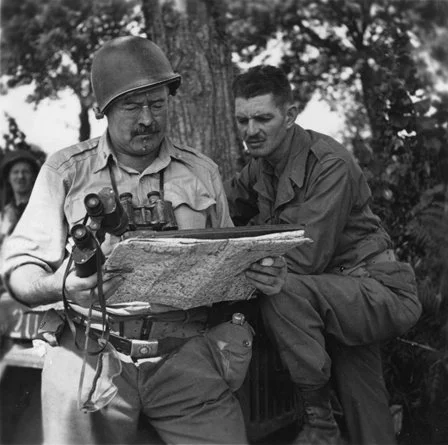
By June of 1944, Ernest Hemingway was already one of the most famous writers in the world, but he was restless. The Spanish Civil War had left a lasting impression on him, and as World War II intensified across Europe, Hemingway felt increasingly pulled toward the conflict. He believed major moments in history had to be witnessed firsthand, not observed from afar. That belief ultimately led him back into a war zone, this time as a correspondent covering the Allied invasion of Europe.
Hemingway secured his role as a journalist through Collier's magazine, which sent him to Europe to report on the war effort. Though officially there to write, Hemingway quickly immersed himself in military life. He spent time aboard ships in the English Channel, flew on dangerous missions, and embedded himself alongside Allied troops preparing for the invasion of Nazi-occupied France.
On June 6, 1944, Hemingway was aboard a landing craft near Omaha Beach during the D-Day invasion. While he was technically prohibited from carrying weapons or participating directly in combat as a correspondent, Hemingway often blurred the line between journalist and soldier. He later traveled through France with Allied forces as they pushed inland following the invasion.
One of the most famous and controversial stories to emerge from this period involved Hemingway allegedly leading a small band of resistance fighters and scouts outside Paris. According to reports from fellow soldiers and correspondents, Hemingway used his connections with the French Resistance to help gather intelligence and assist Allied troops as they moved toward the liberation of the city. Though military officials later questioned whether he had crossed the line from correspondent to combatant, the story only added to the growing mythology surrounding him.
Hemingway was present in Paris during its liberation in August 1944 and famously made his way to the Ritz Hotel, one of his favorite places in the city. Legend has long held that Hemingway “liberated” the Ritz before the arrival of Allied troops, marching in alongside resistance fighters and ordering celebratory drinks at the bar. Whether every detail of the story is entirely true hardly mattered. It became part of the Hemingway legend almost immediately.
The risks Hemingway took during the war would later earn him formal recognition. In June of 1947, he was awarded the Bronze Star for his service as a war correspondent during World War II. His citation praised his willingness to expose himself to combat conditions in order to gather accurate information under fire and communicate the realities of war to the public. For Hemingway, the award represented more than recognition. It reflected how deeply he had immersed himself in the conflict and how seriously he viewed the responsibility of documenting history firsthand.
The war deeply affected Hemingway both personally and creatively. The experiences, friendships, and trauma he witnessed during World War II would influence much of his later work and reinforce his lifelong fascination with courage, fear, survival, and human endurance under pressure.