Across the Pacific, on the Edge of War
In February 1941, Ernest Hemingway traveled through Asia with his wife, Martha Gellhorn, seeking to understand a conflict that foreshadowed America’s entry into World War II.

In February 1941, Ernest Hemingway crossed the Pacific into a region already consumed by war. He did not go as a tourist or novelist in search of atmosphere, but as a working journalist, determined to see firsthand the widening conflict between Japan and China. Accompanying him was his wife, Martha Gellhorn, herself an accomplished foreign correspondent whose reporting would rival, and often surpass, that of her husband.
Hemingway’s purpose was twofold. Professionally, he was reporting for PM, the New York based newspaper that had commissioned him to cover the Far East as tensions mounted. Personally, the trip reflected his long standing belief that writers had a responsibility to witness history directly. Having already covered war in Spain during the 1930s, Hemingway was convinced that the struggle in Asia was not a distant regional conflict but a precursor to a global reckoning.
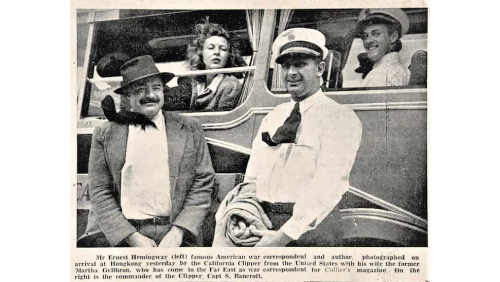
The couple arrived in Hong Kong in early February 1941, then a British colony living under the shadow of Japanese expansion. Refugees crowded the streets, military preparations were visible, and rumors of invasion circulated freely. Hemingway observed the city with a reporter’s detachment and a novelist’s sensitivity, noting the uneasy coexistence of ordinary life and impending disaster.
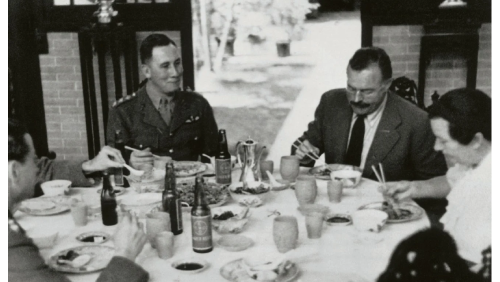
From Hong Kong, Hemingway and Gellhorn traveled into China, reaching Chungking, now Chongqing, the wartime capital of the Chinese Nationalist government, in mid February 1941. There, they met with Chinese officials, including Chiang Kai shek, to assess the resilience of Chinese resistance after years of Japanese bombardment. Chungking bore constant evidence of war, cratered streets, blackout drills, and civilians retreating to hillside shelters when air raid sirens sounded.
Hemingway’s inspiration lay not in military pageantry but in endurance. He was drawn to the stoicism of civilians and soldiers who continued daily life amid destruction. His dispatches emphasized atmosphere and morale rather than strategy, portraying a population shaped by prolonged siege and uncertainty. Gellhorn, working alongside him, produced her own vivid accounts, often focusing more sharply on civilian suffering and displacement.
By late February 1941, the couple traveled onward through parts of Burma, observing the tenuous supply routes that linked China to the outside world. Everywhere, Hemingway sensed the inevitability of a broader war. Japan’s ambitions, he concluded, would not stop at Asia’s borders.
Hemingway left the region convinced that American neutrality could not last. When Japan attacked Pearl Harbor on December 7, 1941, his Asian journey appeared in retrospect as a final warning, an eyewitness account from a world already at war, waiting for others to catch up.